The Parable of the Mustard Seed

When we think of mustard seeds, our spiritual thoughts might take us toward the passage a few chapters later where Jesus talks about how if the disciples had faith as small as a mustard seed – they could move mountains.

But that’s not what the parable of the mustard seed is about.

In this parable – Christ is describing the growth and the greatness of His Kingdom and of Christianity.  And he shows how it begins from the smallest of seeds and grows and grows into the greatest of all movements mankind has ever known.

Let’s look at this short parable one more time – found in Matthew 13:31-32.  It reads:

He told them another parable: “The kingdom of heaven is like a mustard seed, which a man took and planted in his field.  Though it is the smallest of all your seeds, yet when it grows, it is the largest of garden plants and becomes a tree, so that the birds of the air come and perch in its branches.”

Just like in the previous two parables, we see yet another man planting seeds.

Again, the man represents Jesus, and the field represents the world.  Jesus plants his seeds in His field, which is the world.  That reminds us that the world is His.

An interesting note here – the word “Took” in verse 31 is from the Greek word “Labon.”  This word means specifically to “Deliberately take”, or in other words, to take with purpose – to take with thought.  The seed was not planted by chance.  It didn’t just happen – Christ deliberately took the seed, planted it, and nourished the growth.  It existed because of purpose and thought.

A mustard seed is amongst the smallest of all seeds.  But the mustard seed grows into the largest of all the garden plants.  In fact, it was known to provide shade for horses and their riders.  Its large enough for birds to come and perch in its branches.

How is the Kingdom of heaven like this seed?

Well, Christianity began small.  Jesus was one person.  Look at what it grew into from one person.

Also, look at the people he used to grow the Kingdom – the disciples were not exactly the “Dream Team” of the day.

Not only that, but the disciples were told on multiple occasions they were of “little faith” by Jesus himself.

Because the mustard seed is planted – a bush is grown – and birds come and lodge in its branches.  The passage says the birds COME and PERCH or LODGE in its branches.  Oh how true this is for the Kingdom, and for us to be a part of it.

First, we must COME to Christ. (See Matthew 11:28; Revelation 22:17)

But then we must lodge and and live and walk with Christ. (See John 15:4-6; Romans 6:4; Colossians 2:6; I John 1:7)

The Kingdom of Heaven truly is like a mustard seed.  It began small – its growing larger and larger today – and one day – it will overtake all evil and destroy it completely.

Here’s an interesting fact I learned about the Mustard plant.

Pliny the Elder was a Roman author who lived in the first century of the Common Era, He wrote about his experience with the mustard plant in his encyclopedic Natural History: “Mustard… with its pungent taste and fiery effect is extremely beneficial for the health. It grows entirely wild, though it is improved by being transplanted: but on the other hand when it is sown it is scarcely possible to get the place free of it, as the seed when it falls germinates at once.

In other words, for those of us who have been in the south long enough – the mustard plant is very similar to Kudzu.

That’s how the Kingdom began – no one really wanted it – it was small – but it began to grow – and it continues to grow today.  One day, God will take over the whole world with His goodness – will destroy evil – and will reign supreme.

My question to you is this:  wouldn’t you rather be a part of that Kingdom and join it as it spreads its goodness – rather than being part of the evil it chokes out and destroys?



The Parable of the Weeds

parable of the weeds

The parable of the weeds has the potential to make us a bit uncomfortable.  That’s because it tells us two very important things that we sometimes have a hard time understanding.

First, it tells us that whether we like it or not, no matter how good we are, we’ll be growing up with weeds.

Second, it reminds us that in the end, there will be a harvest.  It goes like this (from Matthew 13:24-30):

The kingdom of heaven is like a man who sowed good seed in his field. But while everyone was sleeping, his enemy came and sowed weeds among the wheat, and went away.  

When the wheat sprouted and formed heads, then the weeds also appeared. The owner’s servants came to him and said, ‘Sir, didn’t you sow good seed in your field? Where then did the weeds come from?’

‘An enemy did this,’ he replied.

The servants asked him, ‘Do you want us to go and pull them up?’

‘No,’ he answered, ‘because while you are pulling the weeds, you may root up the wheat with them. Let both grow together until the harvest. At that time I will tell the harvesters: First collect the weeds and tie them in bundles to be burned; then gather the wheat and bring it into my barn.’

The parable of the weeds does a good job of explaining why evil exists.  Have you ever wondered “Why does evil exist if God is a good God?”  I believe the answer to that is found in this parable.

In Matthew, Jesus really demonstrates how He has brought the Kingdom of Heaven to earth.  Once ruled by the evil one, the Kingdom is entering with Jesus, and Jesus has left that Kingdom with us.

But when Jesus brought the Kingdom, there were obstacles in the way, namely Satan and his weeds.  The weeds mentioned here are known as “darnel” or false wheat.  They look the same until the ears mature, and until harvest time you can’t tell them apart.

When the grain matures, you see the real wheat bend over from its weight.  The false wheat, when it matures, shoots straight up and is darker in color.

While the darnel has been growing alongside the wheat, it has wrapped its roots around the real wheat, so pulling up the weeds would pull up the wheat.  To add insult to this, the fruit of the false wheat is poisonous.  If it got mixed in with the real wheat while making flour, it could make the whole batch of flour toxic.

This brings light to the topic of “why are bad things still happening if the Kingdom of God is here.”  The answer to that is the only way evil can be completely wiped off the face of the earth is through the judgement and end of the world.

God delays in bringing judgement on this world though because he knows that the evil ones have wrapped their roots around all of us.  Also, God’s delay in judgement is completely gracious on His part.  He is giving more people time to repent and to come to Him.  We’re reminded of that in 2 Peter 3:8,9

“But do not forget this one thing, dear friends: With the Lord a day is like a thousand years, and a thousand years are like a day. The Lord is not slow in keeping his promise, as some understand slowness. He is patient with you, not wanting anyone to perish, but everyone to come to repentance.”

While the sin that has been brought into the world can be blamed on Satan, we need to remember that Scripture tells us that Satan’s activity never jeopardizes God’s sovereignty, and it also never removes the accountability that we have on our own.  We only sin if WE choose to sin.  I Corinthians 10:13 tells us

“No temptation has seized you except what is common to man. And God is faithful; he will not let you be tempted beyond what you can bear. But when you are tempted, he will also provide a way out so that you can stand up under it.”

I’ve never really liked doing the old fashioned “hell fire and brimstone” type sermons – but you just can’t really avoid it in this parable.  The truth of the matter is this:  Heaven and Hell are both very real – and Jesus describes the two places here.

Hell – Jesus says – is reserved for everything that causes sin and all who do evil.  What will happen to them?  They will be thrown into the fiery furnace, where there will be weeping and gnashing of teeth.

Oh, but the righteous – he promises – get this – radiant glory.  Those who do God’s will by becoming disciples of Christ.

The harvest is coming.  I can’t stop that, nor do I want to stop that.  One day, Jesus will come and bring together all the good wheat, those who have dedicated to living their lives for Him, and take us all home to be with Him – for eternity – and Jesus promises us radiant glory.  I know I can’t be alone in saying that sounds so much better than what is reserved for the weeds –

Why I Love Granny White (The Church, not the Person) Part Deux – The Age Factor

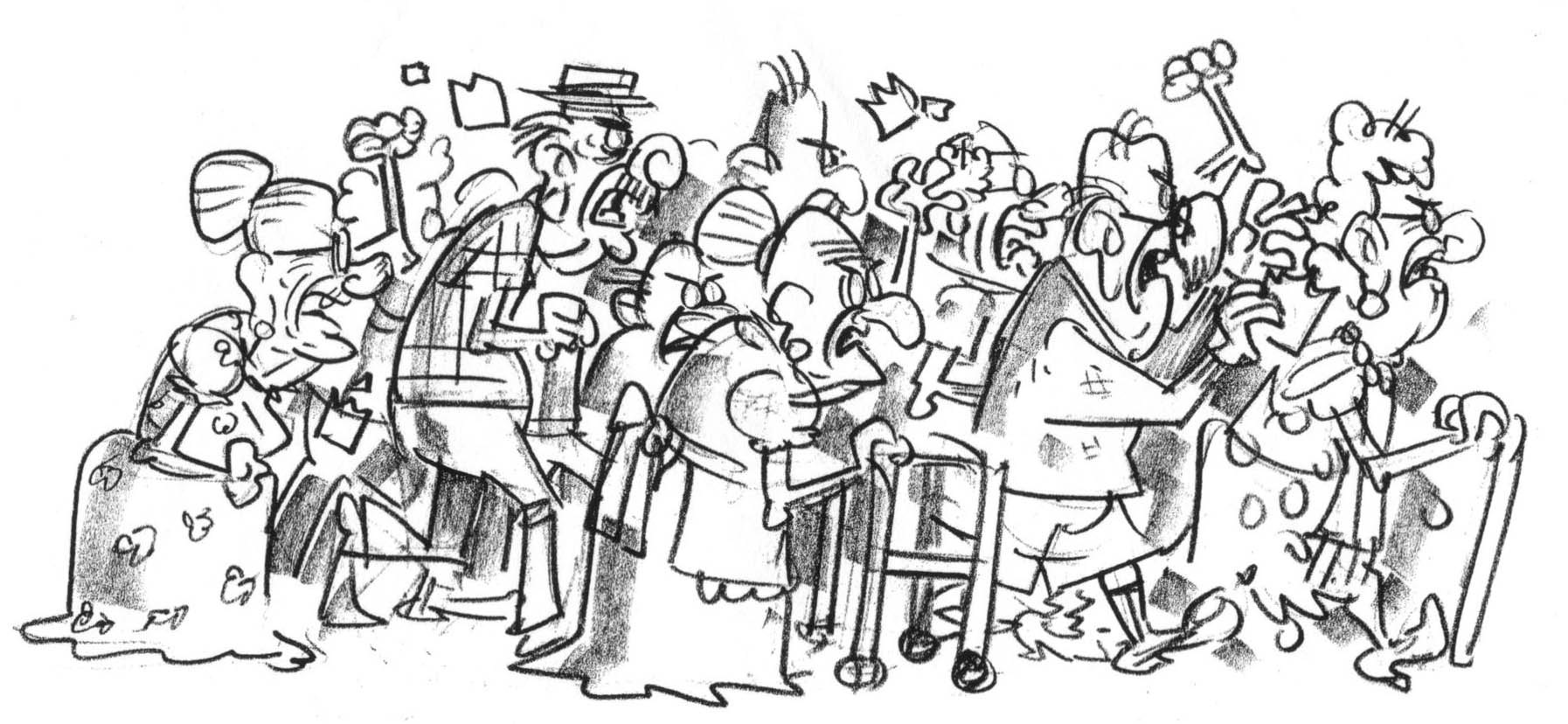
This is NOT who we are!

This is NOT who we are!

One of the common misconceptions about the Granny White Church of Christ is that we are full of really, really old people. I hate to spoil your impression – but today, I want to tell you who the Granny White Church of Christ really is – today in 2013.

Since I have been here, I have heard all sorts of comments from all sorts of people from Nashville (all of these true, I’ve actually heard these things from real people spoken directly to me…) –

“Its great they’ve finally got a young family to go there”

“Did you drop the average age to 80 when you got there?”

“I’d love to visit, but I’m looking for a place that has a program for our children.”

“I don’t care for a worship service that only sings older songs.”

“My grandparents told me not to go to Granny White to church when I came to Lipscomb because they are an old church that doesn’t do anything contemporary or modern. In fact they told me to go anywhere BUT Granny White, because people there are stiff – we used to call them the ‘Frozen Chosen’”

The list could go on and on. I just have to finally put an end to all of this.  I would just laugh it off, but exterior opinions based on false beliefs hurt people.

First of all, Granny White Church of Christ is the name of our location, and that is all. We could easily be called anything else – but please don’t the name of a place keep you from coming in the doors.

Second – Granny White is a loving, committed church family, and just like any family, we have all generations represented.

Or in other words, we’re not just old people.

Now, don’t get me wrong, we have older people, just like EVERY church. But we also have young families, singles, teenagers, children, middle aged families, babies, pretty much every age demographic you could imagine.

In fact, I guarantee you that if you come to be with us, there will be someone who is your age here in our family.

We have a thriving youth group led by one of the coolest guys around – Scott Tillman. He and his wife, Michelle, along with about 10 other volunteers, lead our youth group.

In fact, we’re a family of about 330, and we have 70 kids in our group from grades 12 and under.

We have a thriving young families ministry, led by Jeff Wilson, entitled the “Ark Builders” group.

We have a thriving children’s ministry led by Jeff, his wife, my wife,  and several other volunteers.

We have a young professionals group that averages anywhere from 20-30 people on any given Sunday. This is made of singles and young marrieds without children.

We have groups for our older members as well -“Oasis” and “Gran-Timers”- for our members who are older.

We’ve got a nursery and everything for babies – and we have plenty – so don’t think everyone will be surprised when your baby cries, because we’re used to it!

I understand that in the past, this congregation was comprised mainly of older people, and there is absolutely nothing wrong with that at all!  But this congregation has grown, expanded, and now has people of all generations.  We welcome anyone.  We have a place for you to work, to worship, to grow, to love and be loved, and most importantly – we teach the truth.

Even if you never grace our doors, I hope that you will understand that GW is a place for everyone.  We love all, and embrace any age person that walks through the doors.  I hope you’ll join us and see for yourself who really makes up the family at GW!

Why I Love Granny White (The Church, not the Person)

Over the next few days/weeks, I want to share with you the many reasons why I love my church family. I am currently serving as the preaching/executive minister for the Granny White Church of Christ. For anyone outside of our immediate area, that name probably sounds rather odd, but we are named aptly for the street on which our building is located, 3805 Granny White Pike. Even though it sounds like it, we are NOT named after a person!

I know that many of you worship with, serve with, and work for wonderful church families. The purpose of these posts are not so I can tell you how much better we are than you. My purpose is really to inform you of the great work this church family is doing.

On September 12, 2011, my family started a new chapter as we moved “home” to Nashville from the West University Church in Houston, TX, and began working with the Granny White Church of Christ (often referred to as GW).

It was hard to leave the dear friends we had made in Houston. The West University Church of Christ is a small congregation in the heart of Houston, struggling to find members due to its urban location, but working hard to further the Kingdom of God.

Long story short, when offered a job here, after much prayer, we took a job at GW and moved to Nashville. We began our ministry, and have been growing ever since.

Over the next few days/weeks, I want to explain to you more why we took this job. I can assure you – I would never pack up my family and make such a big move if I didn’t fully believe in the place, and I fully believed after I met with the elders, members, staff, and friends of the GW Church of Christ, I would not have moved here.

What I will leave you with is this – the people are GW are scriptural, loving, friendly, and on fire for God. There are some amazing things happening here, and we’d love for you to come and be a part of it.

You can always visit our site at http://www.grannywhitechurch.org. For our members, feel free to comment on the blog, facebook post of the blog, or reply to the twitter feed for why YOU love GW.

I Can Do It!

420-belly-fat-trivia-quiz.imgcache.rev1341246765465
I can’t even begin to tell you how hard it is to write this. However, sometimes, you just have to do hard things, right? I can’t even count how many times I’ve written about this topic – countless – but I’m going to bring it up yet again.

I know that I am not a “thin” man. However, I’ve never felt like I was a morbidly obese man.

Today, I found out that officially – I am. If I were to apply for health insurance coverage today based upon my current weight, I would be denied coverage. Fortunately, they won’t raise rates from where you initially qualified, but this is still a very sobering thought.

I will lay it all on the line – and fully disclose a few things. I’ve been trying. In fact, at times I’m rather upset that what I’m doing is not working. Tomorrow marks 300 days without any soft drinks, teas, juices…pretty much anything but water. I’ve also gone 160 days without eating french fries. I’ve given up two of my biggest vices so I can lose weight. But it hasn’t worked.

I lift weights 3-5 times a week. I’ve increased cardio. I’m eating better – but I’m still fat.

There’s nothing more humbling than putting on a pair of pants and having them not fit the right way. There’s nothing more troubling than bending over to tie your shoes and having to stop to catch your breath. There’s nothing worse than having a job where you stand in front of people each and every week several times and feeling like all eyes are on the flaws of your physicality.

Here’s the problem – I don’t really feel like I am “morbidly obese” person. But according to my health insurance, if I were to qualify for the preferred or basic coverage – I would have to lose 31 pounds up to 40 pounds. I honestly feel like if I were to lose that much I’d be a beanpole. But – if I want to save money and have good coverage – I have to do it.

I’ve never really cared that much about reaching a “number” for my weight. But apparently, that number is extremely important for insurance purposes.

Here’s where you come in. The book of James tells us to “confess your sins to each other and pray for each other so that you may be healed. The prayer of a righteous person is powerful and effective.” While I don’t feel like I am confessing a sin, I am asking for prayers that I can be healed of my cravings, my lack of willpower, my lack of desire to stay focused on this endeavor, and that my health can improve.

I know there are people out there who are struggling with more issues than being overweight – but let’s face it, we all have struggles with our identity and our appearance. Will you pray for me? And if you need prayers in this same situation, can I pray for you? Let’s support each other in these endeavors. May God give us the willpower we need to stay the course for good health.

The Parable of the Sower (From my series entitled “Once Upon a Time: Lessons from the Master Storyteller”)

Image

Sunday, we began our new series on the study of the parables.  We began with the “Power” parables from Matthew 13, the first of which is the parable of “The Sower.”  It goes like this, from Matthew 13:1-9 – 

That same day Jesus went out of the house and sat by the lake. Such large crowds gathered around him that he got into a boat and sat in it, while all the people stood on the shore. Then he told them many things in parables, saying: “A farmer went out to sow his seed. As he was scattering the seed, some fell along the path, and the birds came and ate it up. Some fell on rocky places, where it did not have much soil. It sprang up quickly, because the soil was shallow. But when the sun came up, the plants were scorched, and they withered because they had no root. Other seed fell among thorns, which grew up and choked the plants. Still other seed fell on good soil, where it produced a crop—a hundred, sixty or thirty times what was sown. He who has ears, let him hear.”

What a great way to start this chapter.  I can easily envision Jesus sitting down on the boat, with no notes at all, looking out in the fields and seeing a farmer doing the very thing he speaks about.  No machines, no tractors, just a bag of seed and a farmer, spreading the seed around his beloved fields.

The farmer is Jesus – and one thing that I quickly notice is that he did not discriminate where the seed was thrown.  If we are to be sowers like Jesus, we need to realize first and foremost that it is not our responsibility to determine whether or not the soil is fertile.  We just need to plant the seeds.

There is a lot of power in a seed.  Such a small item can grow to produce might trees, taller than buildings, stronger than man made items, that produce life and fruit.  There is no problem in the seed that is being thrown, nor in the one sowing the seed.

The problem lies in the soil.  

Many of us as Christians automatically assume since we’ve given our lives to Christ, that we must indeed be the good soil, but I don’t necessarily think that is true.  I believe all of us at one point or another in our lives have evidence of there being a layer of hard soil, rocky soil, thorny soil, and the good soil.

The hard soil is a soil that has been packed down, worn as people and animals have walked on it over an over again.  The seed lands on it, but has no chance at all to dig and grab hold of anything.  Before it has a chance, its taken away by the evil one.

The rocky soil is perplexing.  It looks like normal, good soil.  However, a few inches below lies the rocky layer.  A seed can begin to grow, and even become a sizable plant, but its roots never fully plunge beneath the surface.  We have some woods in our back yard, and the other day I was able to pull an eight foot tall tree right out of the ground, roots and all.  It looked like a tree that was developing, but really, it was just growing on the surface.  It had no chance to survive.

The thorny soil (or weeds) also pose an interesting dilemma for us.  All of us worry about things – but many of us allow the worry to choke out the spiritual.  We let the worry of where our next mortgage payment will come from choke out the blessings that God promised us.  In Matthew 6, Jesus reminded us that if God will take care of the birds and the flowers, will He not take care of us as well?

And finally – the good soil.  We can’t just assume because we’re going to church and living a Christian life that it means we’re automatically part of this good soil.  Good soil allows a seed to grow, take root, and produce fruit.  If we look at the fruits of the Spirit in Galatians 5:22 (love, joy, peace, patience, kindness, goodness, faithfulness, gentleness, and self control), and we’re not producing these things, maybe we’re not quite the good soil we think we are.

Lord, make all of our hearts good soil!


A Year of Regrets?

Image

Its at this point in every year that many blog posts are written about New Year’s resolutions.  People want to lose weight, pack on muscle, make more money, save more money, learn a new skill…the list goes on and on.

And every year, people continually blow it.  They don’t follow through on their resolutions.  I’m not really sure why, but it happens.  Weakness, willpower, control – all reasons these resolutions aren’t fulfilled.

Last year, I didn’t make any resolutions, so it was very easy for me to say on December 31 that I finally achieved exactly what I resolved to do.

But regardless of whether or not you made a 2012 resolution a year ago, and looking past the idea of whether you achieved your goal or not – let’s look at something else.  

Simply – did you have any regrets this past year?

Did you start a 3 month diet plan, and give up after 2 weeks, and then when 3 months had passed by, wonder what could have been if you had just stuck with it?

Did you start maybe something like a P90X workout, and after a few weeks give in to schedule challenges and fatigue, and after 90 days would have been up – you look in the mirror and wonder “Would I have been ripped by now?”

Or maybe, it wasn’t even something you set out to do, maybe it was just something you didn’t do.  

Do you regret wasting away 2 or 3 hours 5 or 6 nights a week watching television instead of reading?  Or playing with your kids?  Or spending quality time with your spouse?

Do you regret not going to church more often?  Do you regret not tackling that home improvement project?  Do you regret not making that investment?  

There are things I regret not doing this past year, and my real goal in 2013 is to not end the year in regrets.  When you have an itch, scratch it.  When you have a passion to do something, do it.  If there’s a book you want to read, read it.  If there’s a project that needs doing, do it.

Don’t make 2013 a year of regrets.