Providing a Second Rate Worship Service

worshiphim1Think about it — the worship service takes up a big bulk of of our Sunday morning.  If a typical morning service lasts an hour, probably 20 minutes of that will be devoted to singing, scripture and prayer time.  Ten minutes may be devoted to Communion.  20 -25 minutes will be devoted to sermon time.  5 minutes will be devoted to announcements.  This post is to discuss the thoughts of chapter 3 of the book 10 Stupid Things That Keep Churches From Growing” by Geoff Surratt.

I could very easily rant about this one for a very long time.  Worship in song and scripture and prayer has always been a very important thing to me.  I remember sitting in chapel at Friendship Christian School, when no one else would sing, I would be singing.  I was the go to worship leader for our youth group at Maple Hill.  On mission trips, if you volunteer one time to lead songs, you’re stuck with it.

At three of the four churches I have worked for now, I have been a worship minister.  I may not be the best singer in the world, but I feel like I have a talent for putting together a worship service effectively.  I started doing this when I was a child, singing and performing in front of others.  I used to think that if you had a desire, and you had a decent voice, you could lead worship.  I also used to think that if you just had a good voice, you could be a song leader.  I’ve learned that this is simply not the case.

I prefer the phrase “leading worship” or “worship leader” over “leading singing” or “song leader”.  When I put together a service, its much more than just songs.  Its scriptures and prayers and songs all combined.

For one to just randomly pick out songs and throw them into an order of worship is just not right in my opinion.  There needs to be purpose.  Verses of songs need to connect together.  Scriptures should tie in.  It should take the worshiper to a place where they can let the Spirit of God overflow out of them, and not just sing a few songs that sound nice.

Too many leaders just pick out a few songs that go with an agenda, such as make sure you pick out an invitation song that tugs at your hear, lead a song with the same key word as the sermon in the title before the sermon, and make sure the closing song is peppy.  Be sure the Communion song makes you focus on the death of Christ.

I don’t subscribe to that theory.

Worship should flow from one end to the other.  It should encapsulate the entirety of heart and mind.  We should have a purpose and direction with our worship.  If the theme of the day refers to all older and slower songs, then use those.  If the theme of the day is upbeat and talks about new ideas, maybe new songs with a fresh take on things are the prescription.

I talked about this before about trying to balance new songs and old songs in a worship service.  Ultimately, if there is no heart or dedication behind the service, none of it matters.  A worship leader can not expect the members of the church to really get into their worship when the worship leader himself has not even gone over the songs.

This topic also encompasses a right or wrong mentality of whether we can clap or not, whether we can use instruments or not, whether we can have a praise team or not, etc, etc.  I grow so weary of the church majoring in minor issues over whether these things are doable, acceptable, or sinful.  Some people act as if when you lead a new song that you may as well go ahead and sign up the whole church for failure.  If a child, or even an adult, claps during a song, there are people who will literally stop their own worship, and enter into the sin of judging.  If a person feels the need to raise their hands to God, whether all the way or just out in front of their own personal space, other people may think they are trying to show off.

When a congregation asks people not to do these things, they are guilty of telling people how to worship God, which I don’t feel is out place.  Yes God said to worship in truth, but before that he said to worship in Spirit.  We are called to make a joyful noise to the Lord.  David danced before out God in a time of worship.  Teenagers are dropping out of church after high school in record numbers, and all some churches care about is making sure they don’t clap on their way out.

So what would happen if all worshiped in spirit and truth.  What would happen to our worship if we removed the stigmas placed on songs we don’t like, people we don’t like leading the worship, time restrictions we put on the service, or even the physical acts of worship we can participate in?

haiti

Jason, with Jean Robert, teaching the men and women at the Preacher's Training Seminar in Haiti.

I’ll never forget being in Port-au-Prince, Haiti with my good friend Jason.  We were conducting a preacher’s seminar there.  Neither of us spoke the Haitian Creole, which is a blend of French, Spanish, Portuguese, English, and some African languages.  People had traveled from all over Haiti to be there. Wives sat in the back, husbands sat in the front.  The building was reminiscent of a covered shelter at a state park.  The floor was part concrete, part packed down dirt.  There were primitive pews and broken chairs crammed into this small worship space, that could not have been more than about 1800-2000 square feet.  Inside, there were about 200-250 people packed tightly.  Jason and I, getting rather claustrophobic, but also not understanding what was going on, decided to step out the front door and just listen.

The singing that night was mind-blowing.  Never had I experienced such a euphoric worship service.  There was swaying, dancing, clapping, foot stomping, hand raising, but most important – joy and emotion.  There wasn’t one person who refrained from giving themselves completely over to God in that worship service.  There came a time when everyone was to pray.  I have to admit, at first it was a bit scary.  Everyone started talking, with their eyes closed and hands raised.  We asked our translator what was going on, and found out they had asked everyone to pray to God on their own.  That experience was phenomenal.  Men and women, on their knees with tears streaming down their faces, praying out loud to God, all at the same time.  People were even coming in off the street to experience  this.

I had a moment that night as well.  I realized that I would never experience that.  Not in that way.  Its just not how we do things here.

When we have someone who just gets up and picks a few numbers out of the song book, and someone who just gets up to pray, and someone to ask God to help us remember the sacrifice of Jesus during communion, and we do this over and over and over and over again, I gotta tell you, it gets old.  And if our heart never changes or grows, and if our heart is never filled while do this, I’m afraid it gets old to God as well.

There’s a great blog entitled “Upgrading a Church of Christ Worship Service Without Buying a Guitar” that you can read.  I find it to be pretty descriptive about how things are in our brotherhood.  I hope all of you will understand that it is up the entire congregation to make the most of your worship service.

I have many many more thoughts on this, but I will stop for now.  I welcome any and all comments.

Establishing the Wrong Role for the Pastor’s Family – Chapter 2

Continuing in our review of the book “10 Stupid Things That Keep Churches From Growing”, we look at chapter 2 – “Establishing the Wrong Role for the Pastor’s Family”.

In my career as a minister, I’ve heard it said every time during an interview, whether jokingly or not, that the church hoped to get a “Two for one” special with my wife.  Sadly, there are many churches that expect the family of a minister to have as big a role in the their ministry as the minister himself.  It is not the job of my family to preach, teach, clean up, set up, organize, follow through, establish, maintain, or anything else with the church.  Their place in ministry should be strictly voluntary, and not mandatory.

Too often times, a minister’s wife has a full time job, and then will teach a class, sing on a praise team, work in the nursery, and host a fellowship meal all on the same Sunday.  It has gotten to the point where we have set priorities in our family.  My wife will not teach on both Sundays and Wednesdays.  In fact, she has taken over the responsibility as the ministry leader for our Women’s Ministry.  While my wife loves working with children, and has a degree and experience in that field, that role is filled with a Children’s Minister at our congregation.  She has found a different way to serve.  But that was her decision.

I’ve known many ministers who have lost their families due to an unnecessary amount of stress placed on the family.  This may not be on an actual role for the family, but for the minister himself.   The role in that situation is that the Family assume the role of second place.  That could be even worse than expecting the family to do extra things for the church.

I think the role of “Minister’s Wife” or “Pastor’s Wife” could be one of the most challenging roles in the world.  We as ministers need to realize all the stress they go through.  As a worship minister, I do not get to sit with my family hardly ever on Sunday mornings during the service.  We’ve tried, but our daughter is at a point where she needs to be close to a door to be taken out at any moment.  My wife does so much on Sunday morning, but there’s little we can do to change our situation.

So, my wife selflessly gives of herself for my ministry on Sunday morning.  However, I know I’m one of the lucky ones.  My wife knew what she was getting into, and accepts that there will be times like this.  My prayer is that churches and ministers alike will understand that it is all too easy to just assume that the minister’s family is at their disposal.  God established the family before the church was ever established.  Let us never forget how important our families are in our ministry.

10 Stupid Things That Keep Churches From Growing — Chapter 1 — Trying To Do It All

As we begin this review, we start with the first chapter entitled “Trying To Do It All”.   I think the funny thing about this chapter is the inevitable fact that all ministers in churches that are small understand exactly what this means.  Let’s just look at it from the example of the church I work for now.  My title is Associate and Worship.  However, I am in charge of Life Groups, finding teachers for our Teen group, preparing all the slides for our worship service, running and maintaining the website (www.westuchurch.com), working with our families, occasional bulletin editor, in house technical guru, class teacher, and many other things.

Our minister is the same way.  Not only is he the preaching minister, but he’s the office manager, bulletin editor, class teacher, sounding board for disgruntled members, and many more things as well.  When you work with a small church, you have this dilemma because there are much fewer workers in the church.

The author Geoff Surratt makes 4 points about “How to Give Away Your Job in 4 Simple Steps”.  His ideas are:

1.  Connect the Dots –

“Your people want to be part of a big mission.  Simply teaching a class, sweeping a floor, or printing a bulletin is not a big mission.  people will grudgingly do theses types of menial tasks until they can find a way out.  On the other hand, when they can see theses tasks connected to a bigger vision of changing their family, their community, and their world, they will arrange their lives around making sure the work is done.”

2.  Make the Big Ask –

“Don’t expect the right people to come forward on their own accord.  Often the people who step up initially are the least qualified for the task.”

3.  Show Them the Ropes –

“The biggest mistake we make as pastors in this area is that we don’t had off ministry; we abandon ship.  Once we find a willing volunteer, we hand her the teacher’s guide adn the class roster and run like heck before she changes her mind.”

4.  Quit –

“Realize that you are currently doing some tasks that you should pass on to someone else, while you are doing other tasks that nobody should be doing.  Pastors who are overwhelmed by ministry often pastor churches with too much ministry.”

I think the hardest part of this is the idea of asking, because many ministers have the attitude of “If I want it done right I’ll just have to do it myself”.  Even if we do realize that its okay to give up something, we too often do exactly what is step #3.  We rush it, and then the ministry fails completely because the person we’ve handed it over to has no clue what they’re doing, and it dies a slow death.

I like the last part of the quote in the 4th step of quitting is amazing, and hard to swallow.  “Pastors who are overwhelmed by ministry often pastor church with too much ministry.”  With churches that are smaller, we really do overwhelm ourselves with too much.  Maybe, the idea of this chapter could not just be pointed towards the leadership, but towards the whole church.

We have 150 members at our congregation.  We’re lucky to have about 40-60 for class on Sunday mornings.  Out of those, about 20 are involved with Sunday School for children.  We then have a Ladies Class, an Auditorium Class, and usually one other adult class.  For the fall quarter, we tried to add a fourth Sunday School class, and it was met with tough times.  We’re not ready for a fourth adult class, and we have realized it.  We are going back to only three in the Winter quarter.

What things are you doing at your church that you are overwhelmed by?  Quit trying to do things that only a larger church can do.  Make sure you are not overwhelming your staff, your elders, your ministers, or your members.  When we burn out on something, its hard to regain passion for it again.

Chapter 2 to come tomorrow.

Book Review: 10 Stupid Things That Keep Churches From Growing by Geoff Surratt

To be honest, I saw this book in a catalog from Group, and thought it was a humorous title, and picked it up thinking it may be more of a comical book than serious.  While the book tends to bring a gentle sense of humor with it,  the 10 chapters of this book are spot on.

Over the next few days, I think I would like to review each particular chapter in this book, and add my thoughts to the author’s thoughts.  This book was written from the perspective of a Pastor in a multi-site congregation in Charleston, South Carolina.  What I really liked about it was that it was not just from his perspective, but at the end of each chapter he asked a different Pastor/Minister to give his thoughts about that particular point.

Pastor’s contributing include Craig Groeschel, Pastor of LifeChurch.tv, Mark Batterson of National Community Church in Washington D.C., and Perry Noble of New Spring Church in South Carolina, who you can link to on the right.  There are 7 others in the book as well, a different one for each chapter.

I’ll start the reviews of each chapter next week, but I thought I’d go ahead and give the chapter names so you could be thinking about them.  In order, they are:

1.  Trying to Do It All
2.  Establishing the Wrong Role for the Pastor’s Family
3.  Providing a Second-Rate Worship Experience
4.  Settling for Low Quality in Children’s Ministry
5.  Promoting Talent over Integrity
6.  Clinging to a Bad Location
7.  Copying Another Successful Church
8.  Favoring Discipline over Reconciliation
9.  Mixing Ministry and Business
10.  Letting Committees Steer the Ship

I’ll try to begin this review Sunday afternoon or Monday.  Till then, Roll Tide.

My Gym and the Church Part 2: The Chuch Connection

God's GymYesterday I talked to you about an observation I have made over the past few months in the gym.  As I work out, daily there are different types of folks who join me in my effort to stay healthy.  We looked at several different “types” of gym-goers.  Today, we’re going to look at the connection from those gym members to church members.
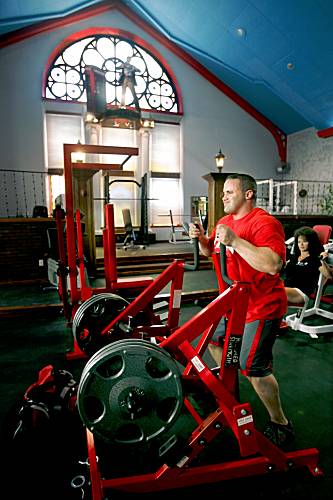
1.  Casual Members: At church, we have casual members as well.  There are quite a few members who come to a gathering of the members just to say they’ve gone “to church”, just like one would say about the gym.  These members typically come in to the auditorium or class and find a seat.  They may open up their Bible, but they don’t really pay attention.  They flip through their Bible to find old notes, or maybe they take this opportunity to read through that wonderful weekly production we call the bulletin.  When they start their worship, its done with lip-service and a smile.  They may partake of the sacred communion, but in heart they’re thinking elsewhere.

After service is over, they may talk to a few people, but their goal is to make lunch plans instead of discuss spiritual matters.  With God left behind on the pew they sat in for an hour, they leave, expecting to see Him in the same spot last week.

2.  Social Members:  Just like the gym goers, there are the same two categories of Social Members.

Beneficial Social:  These are the members who come to church for the benefit of encouraging one another.  Perhaps there is a particular person they connect with strongly, and they have a mutually edify each other.  These members are seen together often in church, but they’re always doing something for the Lord or the congregation.  When they’re together, they’re talking about how they can make each other stronger, and others as well.

Hindering Social:  These are the members who might as well just go to Starbucks on Sunday morning  instead of to the worship service.  They are there for the benefit of each other, and not for the spiritual uplifting of others, or even for God.  They spend a lot of time gossiping, talking about how they hate certain things that are going on at the church, how poorly the song service or sermon was done, how little the sermon applied to them, how cold or hot the building is, how the punctuation in the bulletin is wrong….need I go on?  These people gain strength from each other by tearing other things down.

3.  Status quo Members:  Remembering what we said yesterday,  Status quo is defined as a commonly used form of the original Latin “statu quo” – literally “the state in which” – is a Latin term meaning the current or existing state of affairs. To maintain the status quo is to keep the things the way they presently are. The related phrase status quo ante, literally “the state in which before”, means “the state of affairs that existed previously”.

I think most members fall into this category.  They come to “church” with one purpose, because they need to do so.  This isn’t a bad thing.  They need the relationships, they need the worship, they need the study, they need it all.  However, these members are totally happy not doing anything new.  They are okay with having a similar sermon or sermon style every week.  They are okay with the same order of worship.  They are okay with the occasional stomping on of toes, but not too much.  They want a sermon on baptism every 6 -8 weeks or so.

Status quo members tend to be okay with missing an occasional service for things that pop up.  Their commitment is less to the church they are members of, and more to just being at a church somewhere.

4.  Hardcore Members:  These are the ones I like.  They come to church each week with a mission, just like a hard core gym goer.  They want to stretch, grow, and have their hearts broken and restored.  They don’t care if others see them raising their hands in worship or physically kneeling in prayer, because its not about what others see in them, but its about what God sees in them.  Their goal is to give it all to God, and give what’s left to the church.

These members are excited by new worship songs, new people getting involved, and different speakers.  These members understand that if they do the exact same thing every Sunday and Wednesday, that they nor the church will experience growth of any kind.  They leave with nothing but God in their hearts, because they moved everything else out of the way before they came so God could fill it up.  They can’t wait till the next opportunity to be with everyone else, but in the meantime will be preparing by doing a plethora of Christian-like actions all week.  They will actually pray during the week for the ministers, the members, and for the elders and deacons.  They will spend time during the week with God, instead of leaving Him on the pew till the next week.

Connection

I love the Lord’s church, and I really enjoy going to the gym.  At this moment in my life, however, I don’t exactly know which category I fall into when it comes to the church.  I’m definitely in the Hardcore Membership for the gym.  I love to go.  I spend time during the week planning out nutritious snacks and meals as best I can.  I plan my day around when I go to the gym on the days I work out.

The sad part is I’m not sure which category I fall into when it comes to the church.  I know what I want to be.  I think most Christians who read this will say “Oh, I’m definitely a hardcore member”, but are we?  There are days when I can’t wait to get away and just be by myself and my family.  There are days when I complain about the sermon or the classes.  There are days when I would rather go home than stay for a fellowship meal, but I end up doing these things out of obligation instead of desire or want.

The truth of the matter is, I strive to be a hardcore church member, but often times I’m sucked in by the others.  Let’s face it, these other types have a tremendous impact on us, especially those who may be “status quo” members.  We all have those times when we just come because we need to come.  Guess what?  That’s okay.  Sometimes, we come and gossip or we sit and complain.  While that may not be the best thing for us to do, as long as we’re trying our hardest to be a part of our church family, that’s what is important.

I’ve learned to appreciate the “Beneficial Social” member.  I think God puts the right person in our paths when we need them the most, and sometimes that person may be that sweet lady at church who always asks how you’re doing.  It may be that kind man who always shakes your hand and pats you on the back and assures you that you’re doing a good job.

But, I think we should all strive to be a hardcore member, if for no other reason, for the flexibility in which they enter into worship.  They have the attitude of “whatever happens, its for God, not for me”.  Just like those hardcore gym members say “If its beneficial, no matter how much I hate them, I’m going to squats” or “lunges”.  Sometimes the things we don”t like to do help us the most.  And, when we have that flexibility, I think we would be surprised as to how much God will help us each grow.

My Gym and the Church: The Gym Connection Part 1

gym churchI noticed something this morning as I was working out at the gym — there’s not that much of a difference between those at the gym and the church.  Let me break this down for you:

1.  Casual Members: At the gym, I have labeled the casual goers as the ones who go just to go.  These are the people who sit down at a machine, maybe they know how to use, maybe they don’t.  They will typically sit down on a machine, get it all set, and then play with their music player or send a text message before they begin.  When they finally do a set of exercises, they will put it on the lowest possible weight, and half-heartedly do the exercise, and usually, they do it incorrectly.  I really should video some of the people who are like this, because its often comical.  After one set, they fiddle with their music player again, drink a lot of water, look around, and then maybe they will do another set.

After they are done with one machine, they will get up, while fiddling with their music player, look around for a different machine, and they will do this for about 30 minutes or so, repeating the process each and every time.  Finally, without so much as one bead of sweat on their brow, they head for the locker room.

2.  Social Members: There are two different types of Social Members — Beneficial Social and Hindering Social.  Let’s explore the two.

Beneficial Social — These are the members who come together, or meet each other at the gym on a regular basis.  They work out together, doing the same sets, same exercises, and encourage each other.  They will talk in between sets, usually about how they can do the exercise better.  These people usually get a real solid workout, and leave encouraged about the next time they will work out together.  They leave worn out, but in a good way.

Hindering Social — These are the members who hurt themselves at the gym.  They meet together at the gym, and do a whole lot of the same things that the casual member does, but they do it together.  Instead of fiddling with their music player or sending text messages, they gossip in between sets, and they have full conversations with each other while they exercise.  In order to talk while exercising, they use low weights and don’t even get their heart rates up enough to matter.  They leave, encouraged about the next time they will get together, because this is just a social thing they do together.

3.  Status quo Members —  Status quo, a commonly used form of the original Latin “statu quo” – literally “the state in which” – is a Latin term meaning the current or existing state of affairs. To maintain the status quo is to keep the things the way they presently are. The related phrase status quo ante, literally “the state in which before”, means “the state of affairs that existed previously”

These members come to they gym with one purpose, and that is not to lose muscle, not to gain weight, but to maintain.  These people are happy doing the same routine every single time they step into the gym.  They use the same weights, jog for the same amount of time with the same amount of intensity every day, and are totally okay with it.  While not losing anything from their health benefits, they certainly aren’t gaining much either.

Status quo members also are okay with missing the occasional workout, because hey, life is busy.

4.  Hardcore Members — These are a different breed of gym-goer.  They often come in to the gym with a mission in their eyes.  They have a big gym bag full of protein powder and energy supplements.  They are wearing proper gym clothing.  They may or may not have a music player, but if they do, it has a set amount of songs on it that are meant to pump them up.  They have a goal and a plan when they step into the exercise area.

These members go through a routine, but it changes a lot.  They are continually doing different things to make them grow in different ways.  They understand that if they do the exact same routine every time they come in, that they will plateau and cease to grow.  These people want to grow, either by gaining mass, gaining muscle, gaining extra speed…whatever it is, its in the plus category instead of the negative.  They leave looking better than before they came in, and they can’t wait for their next opportunity.

Connection

Obviously the connections are uncanny.  Part 2 will discuss the Church Connection.

A New Beginning

For a few years, I have been placing my thoughts out there for everyone to see.  While I may not be the most effective or proficient writer, I try my best to write things that will at least provoke some thought amongst my readers.  Ultimately, the blogosphere is a great way to just release your emotions in writing.

I used to always want to be an author.  For the longest time, I wanted to write children’s books.  I also thought it would be fun to write a screenplay.  Recently, however, I’ve gotten into writing devotional thoughts, Life Group guides, and Family Devotionals.

While this site may have a new address, it will still have a lot of the same thoughts, entries, pictures, etc.  It will be a place where I can continue to post pictures of my family, thoughts on ministry, and music and television reviews.  I will also be importing my “Tumblr”/”Twitter” feed.  This is my site for random thoughts, status updates, etc.

I hope you will take the time to re-direct your link to my new address.

Thank you for continuing to read my thoughts.  I hope you will be enlightened and uplifted.

Here goes!

By lanewidick Posted in Random